qwen3.6-enhanced.jinja: CoT leakage into tool turns and why preserve_thinking works now
In my April note on Qwen 3.6-27B I described a stack that survived a long agentic trace: qwen3.5-enhanced.jinja on the 3.6 checkpoint, qwen3_coder for streaming extraction, preserve_thinking=false, and NCCL tweaks after Studio Driver 595.79.
That is the same cluster of reasons preserve_thinking had to stay off: Qwen 3.6 sustains interleaved thinking in a way 3.5 largely does not; qwen3.5-enhanced.jinja does not repair missing </redacted_thinking> and can double-wrap assistant turns on 3.6; with preserve_thinking=true the template keeps more of that broken structure in rendered history, so prefix pollution, CoT bleed, and ignored tool_call get worse. preserve_thinking=false was the pressure-release—stripping much think from earlier turns so agent runs could finish—not a statement that 3.6 “should not” expose reasoning. I dug in when reasoning still leaked into tool_response and tools stopped firing even with the flag off.
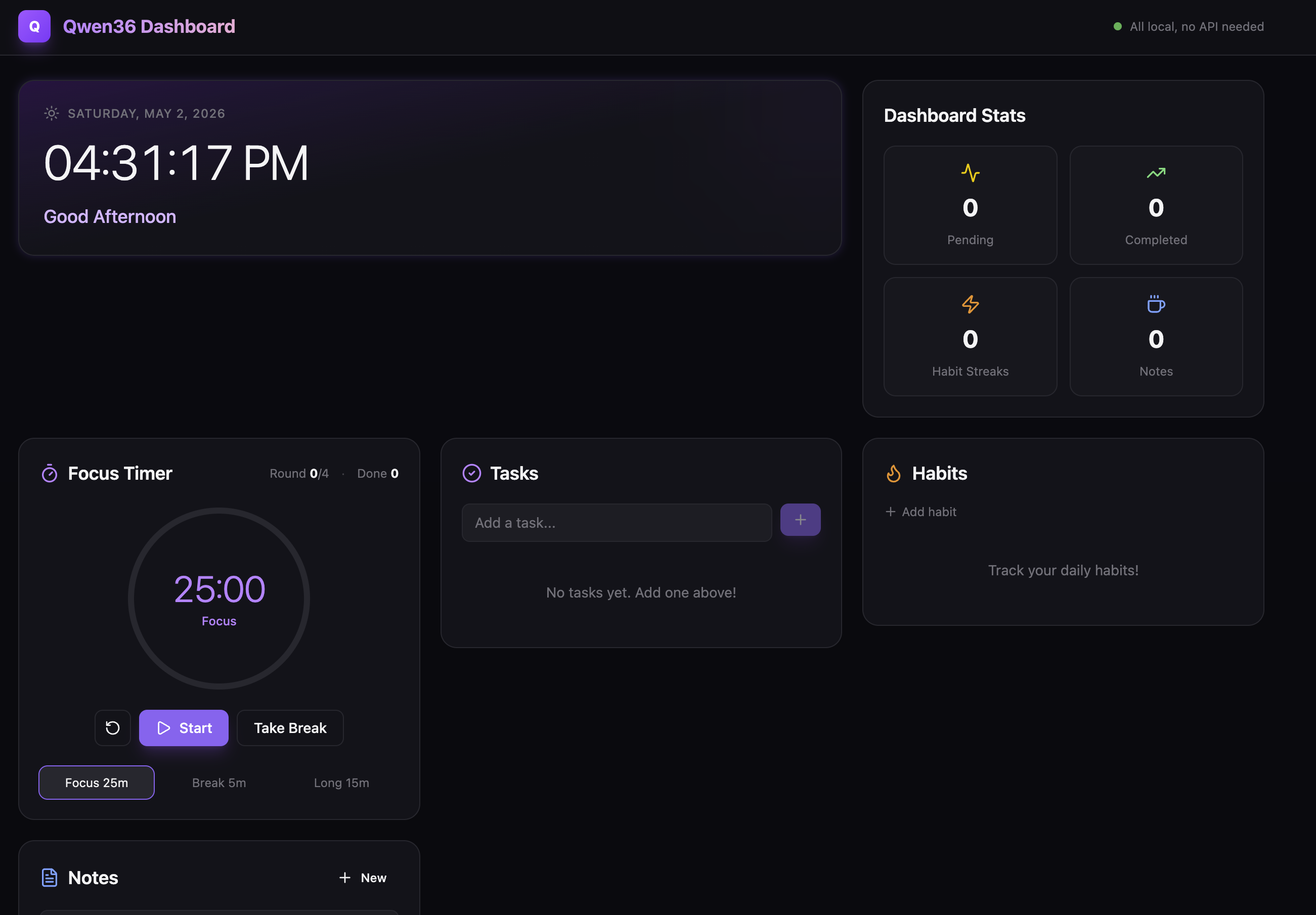
I developed qwen3.6-enhanced.jinja so the Qwen 3.6 family can use an enhanced chat template without that compromise: multimodal paths, interleaved thinking aligned to how 3.6 actually behaves, self-healing before the reasoning split, and preserve_thinking supported (true or false)—i.e. the full surface the 3.6 series is meant to expose, instead of turning off preserve_thinking to paper over 3.5-enhanced-on-3.6 bugs. Raw file for vllm serve --chat-template. Working proof (128k token spent): qwen36_27B_36jinja_project.
This post is the template-side story: why pointing raw qwen3.5-enhanced.jinja at 3.6 could corner the runtime, why that file never inserts a missing </redacted_thinking> (it leaves the broken assistant text in the prompt—causal models still condition on it), and the minimal self‑healing step I put in the assistant branch of qwen3.6-enhanced.jinja before the reasoning split.
What broke in plain terms
Sometimes the assistant emitted something shaped like:
-
an opening think marker (
qwen3.6-enhanced.jinjaandqwen3.5-enhanced.jinjashare the same literal<redacted_thinking>family; the April post usedthinkingcasually for readability), -
no closing tag before a raw
<tool_call>block.
Training and runtime prompts encourage closed think sections. Reality is messier: the model can wedge a tool payload inside what is effectively still “thinking.”
Separately, using qwen3.5-enhanced.jinja on Qwen 3.6 used assistant logic equivalent to wrapping every qualifying turn in a synthetic think sandwich even when reasoning_content stayed empty. That interacted badly with malformed history: after rendering, it could look like the model was still inside an outer think envelope when <tool_call> appeared. Downstream behaviour matches what I observed as CoT leakage across turn boundaries and tool instructions that never get scheduled.
None of this negates qwen3_coder on 3.6—the parser lane still matters—but fixing the template removes a structural failure mode rather than leaning only on parsing heuristics.
Why reasoning extraction silently failed
The template extracts reasoning_content by looking for </redacted_thinking> in the message body. When the assistant never emits that closing tag, the splitter never runs, reasoning_content stays empty, and the remainder stays the full raw string—including the unclosed opening think tag ahead of <tool_call>.
A 3.6-style handler that unconditionally wrapped “post–last-user” assistant text in opening and closing redacted-thinking fences, plus the recombined body, then effectively produced stacked think markup: a vacant fenced block followed by thought text that still began with another dangling <redacted_thinking> ahead of <tool_call>.
From the model’s point of view that is dangerously close to “tool call emitted while still reasoning,” which rationalizes ignored tool XML and follow-up prose that belongs in Think leaking into structured tool payloads.
What qwen3.5-enhanced.jinja actually does (and does not do)
qwen3.5-enhanced.jinja does not repair a missing </redacted_thinking>: there is no pass that closes a dangling opener or strips half-open think markup. Whatever the assistant emitted—including <redacted_thinking> with no matching close before tool_call—can still show up in the serialized prompt the causal model conditions on next step; “letting it be” is input-side pollution in principle whenever that text stays in prefix.
Why the same no-fix workaround looked “fine” on Qwen 3.5: in my runs Qwen 3.5 does not really sustain a long-lived interleaved thinking block the way Qwen 3.6 does—it lacks that stickier “keep thinking open across turns” behaviour. Interleaved chat templating also discards many think segments for assistant turns before the last real user message, so most of the half-open scaffold never re-enters the prefix the model sees. 3.6 is where that stops being a sufficient safety net, so the same “don’t repair the close” policy starts to hurt visibly (CoT bleed, ignored tools) and self-healing in qwen3.6-enhanced.jinja becomes worth the complexity.
Earlier 3.5 assistant logic only wrapped output in an explicit Think block when reasoning_content was non-empty after splitting. With no close tag, reasoning_content stayed blank, the template skipped an extra synthetic think envelope, and the same dirty assistant string (still containing the unclosed opener) was emitted as bare assistant content. That sometimes kept tool_call outside a second layer of scaffolding the template would have invented—helping scheduling—but it did not make the token history structurally clean. On the faulty 3.6-on-3.5-enhanced path, the unconditional wrapper added that outer layer on top of the still-unclosed inner block, which made tool behaviour worse without fixing the underlying transcript hygiene problem.
The fix I settled on
I wanted deterministic repair, not another special case that might leave historic turns ending in <redacted_thinking> without a sibling close before <tool_call>:
-
Self-healing (before splitting):
When both<tool_call>and<redacted_thinking>appear and the last</redacted_thinking>sits before the last<redacted_thinking>(including the-1 / missingcases), inject</redacted_thinking>immediately before the first<tool_call>when that tool call sits after the dangling opener; otherwise append</redacted_thinking>at the end. -
Keep the outer think wrapper unchanged afterward: splitting now sees balanced markers, extracts
reasoning_contentcleanly, and the tool payload never sits upstream of two contradictory think layers.
Roughly—the snippet lives today in qwen3.6-enhanced.jinja; the operative structure is:
{%- elif message.role == "assistant" -%}
    {%- set content = render_content(message.content, true)|trim -%}

    {# Ensure </redacted_thinking> exists before tool XML when opener was left dangling #}
    {%- if '<tool_call>' in content and '<redacted_thinking>' in content -%}
        {%- set last_think = content.rfind('<redacted_thinking>') -%}
        {%- set last_close = content.rfind('</redacted_thinking>') -%}
        {%- set tool_pos = content.find('<tool_call>') -%}
        {%- if last_close < last_think or last_close == -1 -%}
            {%- if tool_pos > last_think -%}
                {%- set content = content[:tool_pos] ~ '</redacted_thinking>' ~ content[tool_pos:] -%}
            {%- else -%}
                {%- set content = content ~ '</redacted_thinking>' -%}
            {%- endif -%}
        {%- endif -%}
    {%- endif -%}

    {%- set reasoning_content = '' -%}
    {# … existing reasoning extraction + interleaved-thinking render … #}
{%- endif -%}
Above, tags match qwen3.6-enhanced.jinja as checked in; if you merge this into another fork, substitute your literal open/close think strings verbatim.
Branches I deliberately did not adopt: emitting a trail-only opening tag <redacted_thinking> immediately followed by a newline wrapper for assistant history when reasoning is blank but the turn qualifies for preservation. That mirrors the add_generation_prompt tail—which is appropriate at generation start—but is incorrect mid-conversation because it nests the next <tool_call> beneath an unfinished think scaffold.
Practical scope
- Surface area: the
assistantmessage branch through the unchangedtoolmessage handler—nothing else needed in my audits (system preamble, structuredtool_callsserialization, trailing generation prompt untouched). - Interaction with knobs: with
qwen3.6-enhanced.jinja,preserve_thinking=trueis a safe option again—histories carry balanced fences after self-healing, so interleaved-thinking strip/keep semantics stay predictable. On bareqwen3.5-enhanced.jinjaagainst 3.6 I still recommendpreserve_thinking=falseuntil you migrate.
What stays the same in the April stack
The April launcher remains the blueprint for parsers, GPUs, MARLIN-aligned FP8, NCCL tweaks, --disable-custom-all-reduce on 595.79, and qwen3_coder on 3.6. Point --chat-template at the local path of qwen3.6-enhanced.jinja (clone or copy from the chat-template/ folder); --default-chat-template-kwargs can then set preserve_thinking to true or false as you prefer (April’s preserve_thinking=false was keyed to qwen3.5-enhanced.jinja on 3.6, not to vLLM itself).
Where I reran transcripts that previously reproduced leakage, executions scheduled reliably again and stray reasoning stopped surfacing downstream of repaired <tool_call> markers; the public trace and code live in qwen36_27B_36jinja_project. Others’ mileage will vary by checkpoint and client parsing, which is exactly why I publish both halves: parser ergonomics plus truthful templating, plus a repo you can clone when a blog post is not enough.
vLLM launch recipe (qwen3.6-enhanced.jinja, preserve_thinking=true)
Below is the vLLM recipe I use with qwen3.6-enhanced.jinja and preserve_thinking: true (the pairing this post is about). I tested this configuration on vLLM v0.19.0; newer or older releases may need small flag or env tweaks. Point --chat-template at your local copy—e.g. from chat-template/qwen3.6-enhanced.jinja. Adjust source …/activate, GPU indices, and paths for your box. Lines that end with \ plus an inline # … can trip some shells; drop those comments after \ if paste fails.
On NVIDIA Studio 595.79 with mixed GPUs I still needed --disable-custom-all-reduce for stability (April note); it is commented here so you can enable it without hunting the flag.
#!/bin/bash
# vLLM v0.19.0 (recipe tested on this version)
# ------------------------------
# Safe, Speed-Focused Env Vars
# ------------------------------
export CUDA_DEVICE_ORDER=PCI_BUS_ID  # mixed-GPU safeguard
export CUDA_VISIBLE_DEVICES=0,1
export NCCL_CUMEM_ENABLE=0
export VLLM_ENABLE_CUDAGRAPH_GC=1
export VLLM_USE_FLASHINFER_SAMPLER=1

export OMP_NUM_THREADS=8

# NCCL tuning for SYS/PCIe topology
export NCCL_P2P_DISABLE=1
export NCCL_IB_DISABLE=1
export NCCL_SHM_DISABLE=0
export NCCL_ALGO=Ring
export MODEL_NAME="Qwen/Qwen3.6-27B-FP8"
export NCCL_P2P_LEVEL=LOC
export VLLM_RPC_TIMEOUT=180
export VLLM_WORKER_MULTIPROC_METHOD=spawn

# --------------------------
# Clean stale FlashInfer cache
# --------------------------
rm -rf ~/.cache/flashinfer

# Activate virtual environment (change to your path)
source /home/cychan/vLLM/.venv/bin/activate

export VLLM_MEMORY_PROFILER_ESTIMATE_CUDAGRAPHS=1
export VLLM_TEST_FORCE_FP8_MARLIN=1
export VLLM_SLEEP_WHEN_IDLE=1

vllm serve $MODEL_NAME \
  --served-model-name Qwen3.5-27B \
  --chat-template qwen3.6-enhanced.jinja \
  --default-chat-template-kwargs '{"preserve_thinking": true}' \
  --attention-backend FLASHINFER \
  --trust-remote-code \
  --tensor-parallel-size 2 \
  --max-model-len 219520 \
  --gpu-memory-utilization 0.91 \
  --enable-auto-tool-choice \
  --enable-chunked-prefill \
  --enable-prefix-caching \
  --max-num-batched-tokens 12288 \
  --max-num-seqs 4 \
  --kv-cache-dtype fp8 \
  --tool-call-parser qwen3_coder \
  --reasoning-parser qwen3 \
  --no-use-tqdm-on-load \
  --host 0.0.0.0 \
  --port 8000 \
  --language-model-only
#  --disable-custom-all-reduce   # uncomment on Studio 595.79 + mixed GPU if you hit NCCL deadlocks (see April post)

# Optional: Qwen3 MTP speculative decoding (needs headroom; 80B-A3B speculator not on current hardware)
#  --speculative-config '{"method":"qwen3_next_mtp","num_speculative_tokens":5}' \
Summary
The flawed qwen3.5-enhanced.jinja assistant branch aimed at 3.6, combined with sometimes-unclosed <redacted_thinking> markers, yielded double layering after rendering: vacant synthetic think blocks atop still-open reasoning. Downstream failures looked like ignored tools and polluted tool responses—not always mistakable for NCCL deadlocks.
qwen3.5-enhanced.jinja could look less explosive on 3.5 partly because an empty reasoning_content skipped an extra synthetic wrapper—not because it healed think markup—and partly because Qwen 3.5 in my experience does not keep a thinking block alive the way 3.6 does, so prefix pollution rarely compounds. That skip disappeared on the faulty 3.6-on-3.5 path, and 3.6 does sustain interleaved thinking, so preserve_thinking=false on the old file masked double-layer tool failures while dirty prefixes became a first-class problem.
qwen3.6-enhanced.jinja uses pre-split self-healing to insert the missing close where needed so tool_call is not trapped inside an unterminated think region and the serialized history is not stuck carrying an endless “still thinking” span before the tool payload. That is what lets preserve_thinking work without the old trade-off between trace fidelity and clean conditioning. Operationally, keep parser and GPU settings from April; swap --chat-template and revisit preserve_thinking as intended rather than forced off. qwen36_27B_36jinja_project is the end-to-end proof repository for this template path.
Resources
-
qwen3.6-enhanced.jinja(source) — raw qwen3.5-enhanced.jinja(source)- Repository: vLLM Qwen 3 / 3.5 / 3.6 chat-template fix —
chat-template/ - Proof:
qwen3.6-enhanced.jinjaagentic run — qwen36_27B_36jinja_project - Prior field note: Qwen 3.6-27B on vLLM with
qwen3.5-enhanced.jinja— Reddit discussion - April demo project (
qwen3.5-enhanced.jinjaon 3.6)
Enjoy Reading This Article?
Here are some more articles you might like to read next: